Criminal law · Intake

In criminal law, the clock is set by the police and the court. Not by your opening hours.

An interview under caution at the police station on a Saturday, a magistrates’ court summons for a hearing in three weeks, a trial date in the Crown Court: these enquiries arrive out of hours and they do not call back. Lorne & Vale captures the enquiry, structures it into a triage brief and puts it on the right lawyer’s desk, with a first-response target of 4 hours when it is scored P1. You keep the decision.

  • Human review on everything
  • No legal advice
  • Live in 7 days
  • Isolated per firm
Harry Lawsonharry.lawson@example.invalid
Summons to the magistrates’ courtHello, I have received a postal requisition to attend the magistrates’ court. The hearing is in three weeks and I have not spoken to a solicitor yet. Could you call me back?
Direct e-mail · a weekday eveningThe office is closed
Fictional person, address reserved for examples.
  1. Received
  2. Structured
  3. Routed
  4. Acknowledged
  5. On the iPhone
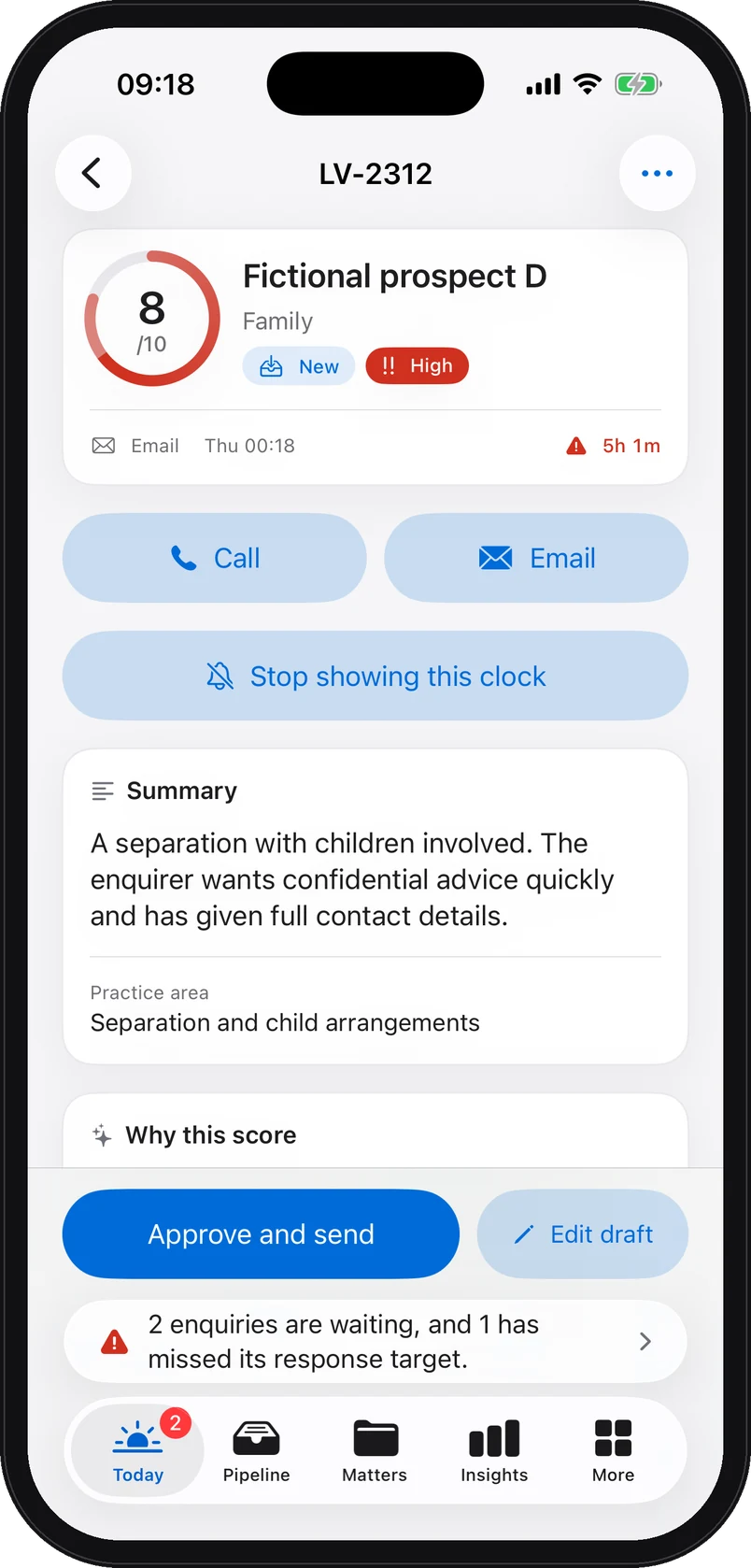
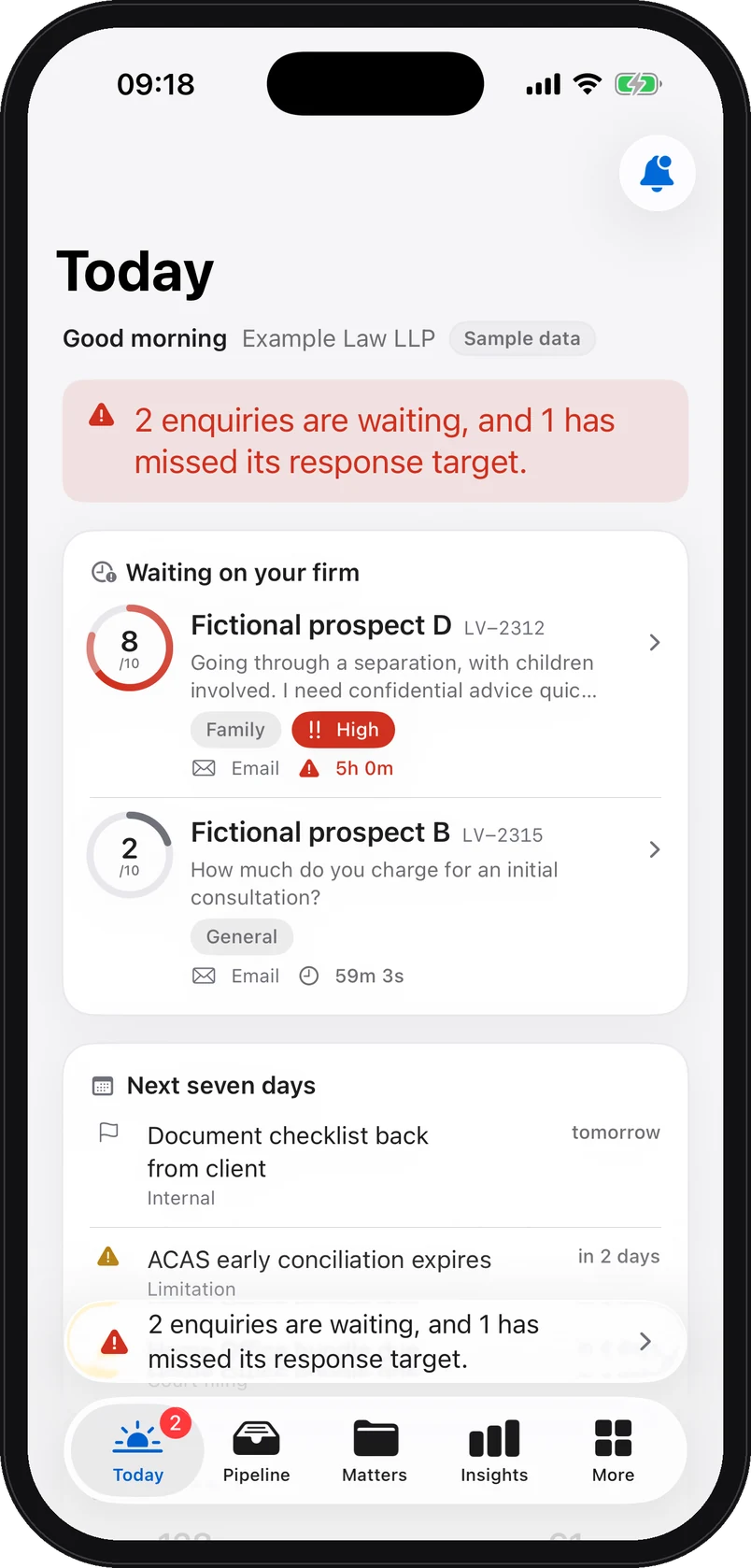
The Lorne & Vale iPhone app, Today screen: two enquiries waiting on the fictional firm, the first a family-law enquiry from a fictional prospect scored 8 out of 10, high urgency, past its response target.

Real platform and app, fictional firm and people. The iPhone screen shows the sample data available, a family law enquiry; the enquiry above is a further example and the reading grid is the same in criminal work.

A week in a criminal law firm

Three situations you will recognise.

Every enquiry arrives with a triage brief: summary, urgency, parties to check, missing information, documents to request. Here is what it would surface.

Saturday, 22:30Missed call

An interview under caution, at the weekend

“My brother was arrested this morning. He is still at the police station and they are talking about interviewing him. I am trying to find a solicitor for him.”

What the brief would surface
Urgency
High. Priority P1, first-response target of 4 hours. Watch points: a person in custody, and the person writing is not the person concerned.
Parties to check
The person in custody and, if they are named, the alleged victim, for the conflict check.
Missing information
Which police station and which force, what time he was brought in, whether the duty solicitor has already been called, and how the caller is related to him.
Documents to request
Little at this stage: the custody reference and the station name if they are known, and any notice handed to the family.
Tuesday, 22:05Website form

A magistrates’ court summons, hearing in three weeks

“I have received a postal requisition to attend the magistrates’ court. The hearing is in three weeks and I have not spoken to anyone yet.”

What the brief would surface
Urgency
High. Priority P1, first-response target of 4 hours: the hearing date is already fixed.
Parties to check
Any complainant named in the document and any co-defendants, for the conflict check.
Missing information
The court named on the document and the date on it, which document was actually received: a postal requisition, a summons, or a charge with a first hearing date given on police bail. Are there bail conditions in place?
Documents to request
The requisition or summons itself, the bail notice, the record of any police interview, and evidence of income for a legal aid means assessment.
Monday, 08:40Forwarded e-mail

A Crown Court trial date, and a change of solicitor

“My case has been sent to the Crown Court and I have a trial date in the spring. I am not happy with the firm representing me and I would like to move.”

What the brief would surface
Urgency
Medium. Priority P2, first-response target of 24 hours. Watch point: a listed trial date and a transfer of representation.
Parties to check
Any co-defendants and the firm currently on the record, for the conflict check.
Missing information
The court and the case number, the trial date and the stage reached, whether he is on bail or in custody, and whether the case is privately funded or on a representation order.
Documents to request
The indictment or charge sheet, the case management directions, the representation order, and the current solicitor’s details.

Illustrative examples, fictional people. What a brief contains depends on the enquiry received. The brief summarises, scores and flags; it does not advise and it decides nothing. Someone at the firm assesses the merits and replies.

Demonstration

A demonstration on a real enquiry.

The screens below are the product’s, on the demonstration firm’s sample data: Charlotte Bennett, a fictional person, writes at 22:47 about a separation. That enquiry is family law; the reading grid is the same in criminal work. It is structured within the minute, the acknowledgement goes out in the firm’s name at 22:49, and the brief waits for the lawyer on the platform and on their iPhone.

The triage brief

What the lawyer reads before deciding.

The same grid at 2 pm and at 11 pm. Nothing is decided in their place.

  • Score 8 out of 10, hot, priority P1, with the score rationale in plain words. In criminal work, an interview under caution about to start or a hearing already listed fall under the same P1 priority, with the same first-response target of 4 hours.
  • Practice area, routing and next step. On the screen shown: family law, a suggested first contact, a confidential call. On a magistrates’ court summons, routing would point at the crime team and the recommended step would be a call back before the end of the day.
  • Needs attention. The screen flags children involved here. In criminal work it is a person in custody, a hearing date close at hand or bail conditions that surface in the same place.
  • Missing information and documents to request. What you need to know before the first call, and what the person should bring: on a summons, the document received, the court named on it and the hearing date.
  • Counterparties and conflict check. Names are extracted by the model and require human verification: in criminal work, the complainant and any co-defendants.

The person’s identifiers are replaced by tokens before any model call. Names are restored only inside your firm’s database.

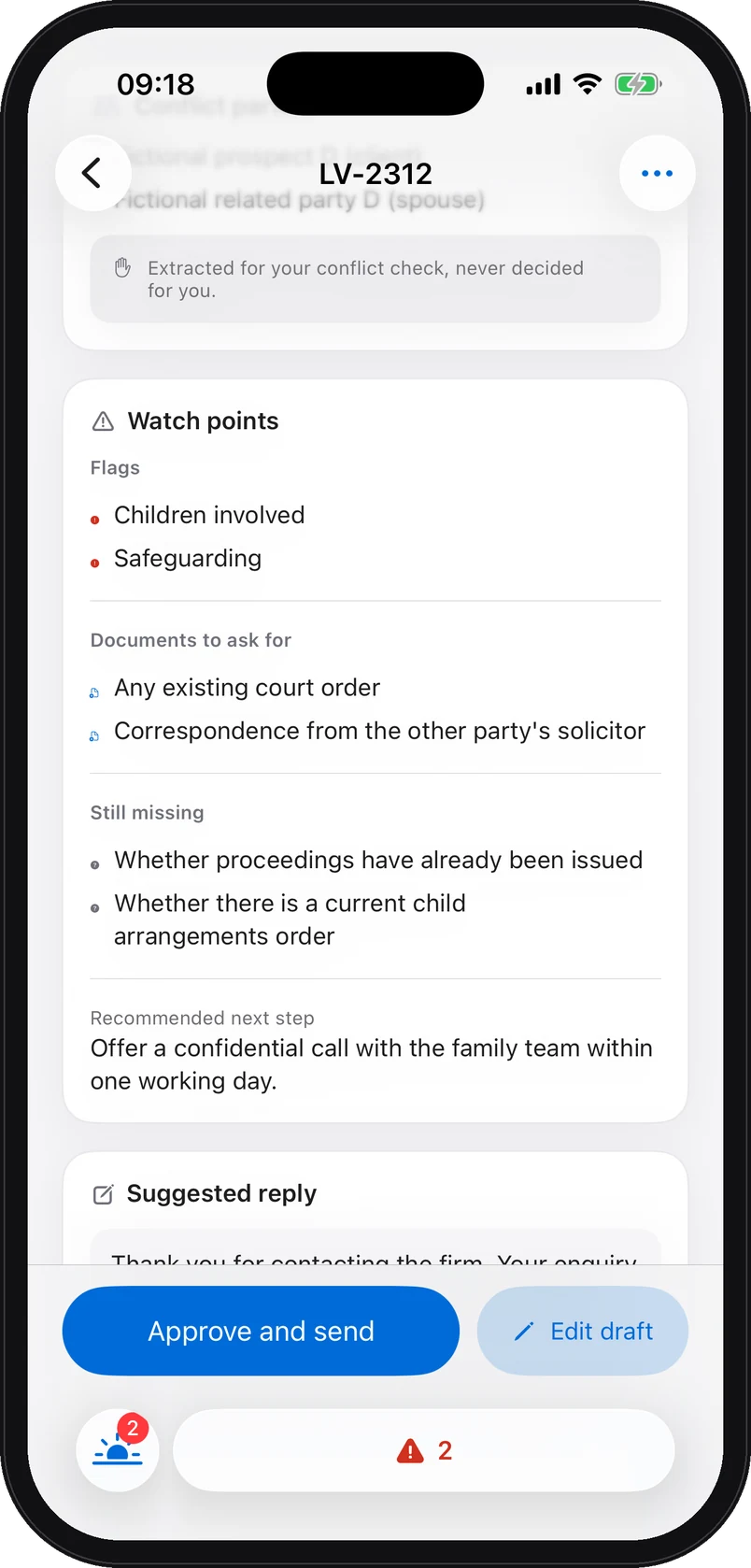
The triage brief on iPhone: watch points, documents to ask for, missing information and the recommended next step, on a fictional family-law enquiry.
Triage brief of a fictional enquiry on the platform: score 8 out of 10, family law, priority P1, recommended next step, score rationale, watch points and parties to check.
On the iPhone

The same brief, in the pocket of the lawyer on call.

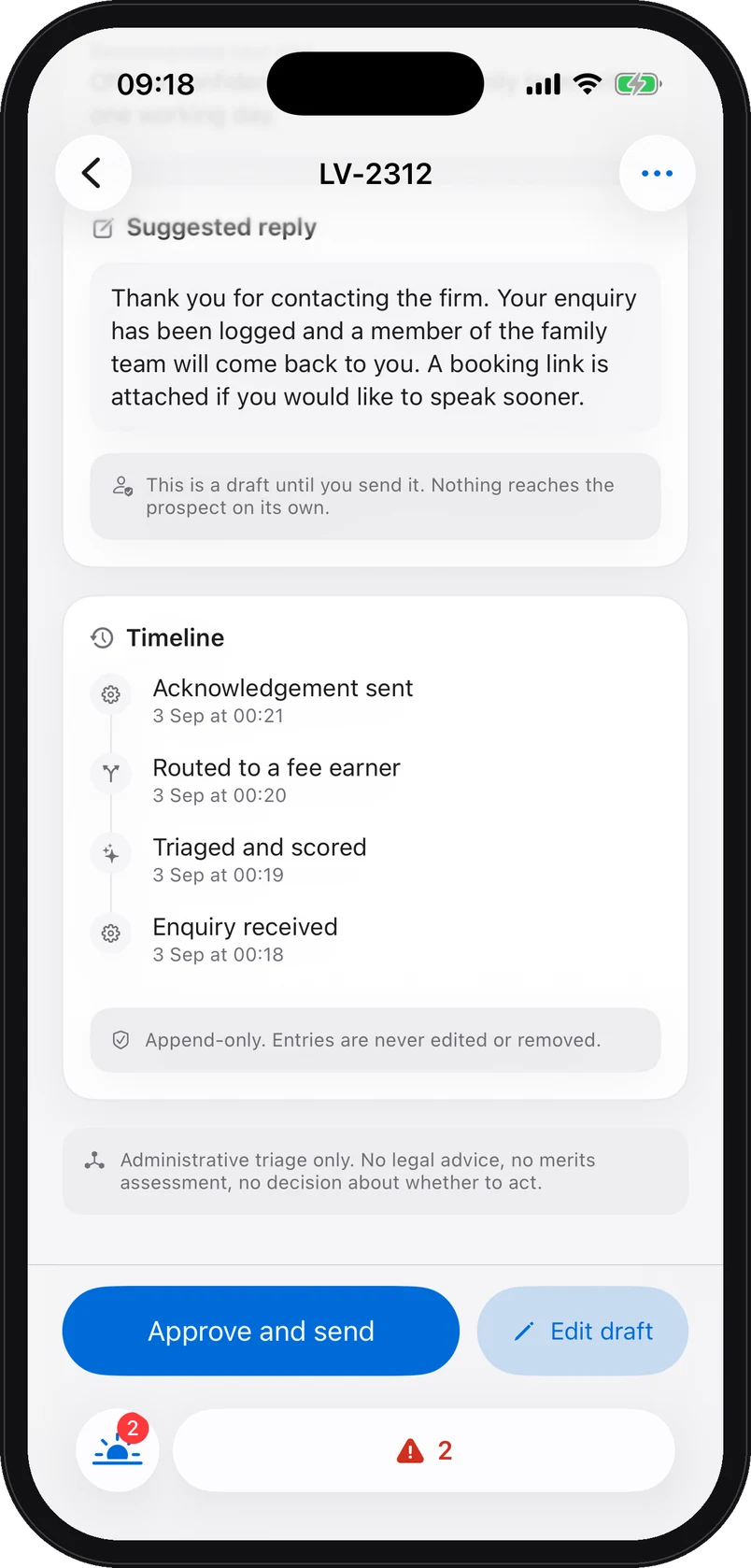
What is waiting, with its countdown. A suggested reply, marked as a draft. Two buttons: Approve and send, Edit draft.

  • A countdown on the lock screen, if the lawyer asks for it, and a reminder half an hour before the response target runs out. The reminder names a practice area and a score, never a client.
  • A draft, not a send. The suggested reply only goes out if a lawyer approves or edits it. The only thing that leaves on its own is the acknowledgement, in wording approved at setup.
  • An append-only history: received, triaged and scored, routed to a fee earner, acknowledgement sent. Entries are never edited or removed.
  • Face ID locks the app as soon as it goes to the background.
The triage brief on iPhone: score 8 out of 10, a fictional prospect, family practice area, high urgency, summary, and the Approve and send, Edit draft buttons.
The suggested reply on iPhone, marked as a draft until it is sent, and the append-only timeline of the enquiry: received, triaged and scored, routed to a fee earner, acknowledgement sent.

Real platform and app, fictional firm and people.

What it is worth

A worked example, with its assumptions.

Not a promise: visible arithmetic, to redo with your own numbers.

Assumptions for a firm of 3 to 9 lawyers
£67,500of fees at stake a year, in this example, that is 27 matters
Enquiries received a month, all channels30
Share unanswered, answered too late or never read30%
Conversion of an enquiry handled in time25%
Fees on a criminal defence matter, in a range of £1,500 to £6,000£2,500
Annual subscription, Firm tier, list price£11,940
Break-even5 matters a year

30 × 30% × 25% = 2.25 matters a month × 12 = 27 × £2,500 = £67,500 a year

“At stake” means the fees of the matters concerned, not a forecast of instructions or guaranteed revenue. This example costs a criminal defence matter between £1,500 and £6,000 and takes £2,500 from that range; put your own figure in its place. The setup fee, refundable in full, is left out of the calculation.

What the research measures

67%

of law firms never reply to an enquiry sent by e-mail.

Source: Clio Legal Trends Report, secret-shopper study of 500 law firms, 2024. The figure describes observed response behaviour, not a result to expect from Lorne & Vale.

Security and confidentiality

Enquiries this personal, handled as such.

Four controls you can verify, described without superlatives.

Anonymised before any model

Names, e-mails, phone numbers and other identifiers are replaced by tokens before an enquiry reaches a model. The mapping is sealed under the firm’s key.

Isolated per firm

Every client-data table carries a per-firm access rule, checked by automated tests on every change.

Documents sealed in the browser

Every document is encrypted before upload under two key exchanges, X25519 and ML-KEM-1024. Uploads are bounded, type-checked and content-inspected: embedded programs are refused.

Chained, signed audit trail

Sensitive actions are hash-linked and the head of the chain is signed daily with ML-DSA-87. The iPhone app verifies the signature on the device.

What we do not claim: no SOC 2 or ISO 27001 certification, and no external penetration test to date. Hosting on Supabase (EU, Ireland) and Vercel; the model is called through a server-side proxy, with no training on your data under OpenAI’s default policy.

Pricing

A flat fee for the whole firm.

Criminal law is the practice area included. An additional practice area is £250 per month. No per-seat or per-enquiry charge. A one-time setup fee, refundable in full under the No-Miss Guarantee. Prices exclude VAT.

Live in 7 days, a 60-day pilot then month to month, cancel any time, export your data any time. Read the guarantee in full.

Intake audit · 15 minutes

See what this would change in your firm.

Fifteen minutes with a founder. Your channels, your volume, your criminal law enquiries, and what happens in the evening and at the weekend. You leave with a costed estimate and a clear answer, including if it is not for you.

Prefer to write first? contact@lornevale.com