Your firm has its own space
Data is separated by firm, with permissions tied to team roles.
How it works
Access rules apply at the database. A member of one firm does not gain access to another firm’s data through their account.
View the detailLorne & Vale security
Your matters remain sensitive long after they close. Our architecture combines classical and post-quantum encryption to prepare your documents for what comes next.

Your documents
encrypted
Their keys
protected by two approaches
The audit log
verifiable through signatures
Post-quantum, explained
Post-quantum describes cryptographic methods designed to resist attacks by sufficiently powerful quantum computers. They run on the devices your team already uses.
What it means for you
An identity, a negotiation, a legal strategy. The goal is to preserve the confidentiality of information whose value lasts for years.
Explore the “harvest now, decrypt later” scenario.
Today
A contract, an identity document, a defence strategy. You share information whose confidentiality matters long after the first exchange.
An attacker could record encrypted exchanges without being able to read them at the time.
The risk starts with the copy
Time passes
A closed matter still contains names, commitments and private information. The end of your work does not end their value.
Changing protection later does not recall a copy already held by a third party.
Confidentiality has a lifetime
Tomorrow’s challenge
A sufficiently powerful quantum computer could compromise some classical key exchanges. A retained copy would then become a target for a new decryption attempt.
Post-quantum cryptography aims to protect key exchange against this future threat. Its value starts with documents sent today.
Prepare the protection now
Educational scenario, with no predicted arrival date. Learn more: NIST’s explanation
Hybrid protection
Content is encrypted with AES-256-GCM. To protect its key, we combine X25519, a widely studied classical approach, with ML-KEM-1024, a post-quantum approach.
Understand by changing an assumption
Educational simulationThe classical approach
A widely studied foundation
Assumed secureThe post-quantum approach
A different mathematical foundation
Assumed secureTwo secrets combined to protect the document key
AES-256-GCMSecrets from X25519 and ML-KEM-1024 are combined to protect the document key. The hybrid principle spreads trust across two mathematical approaches.
In this scenario, X25519 would be compromised. ML-KEM-1024 still contributes its secret to the combination. This is its intended role against a quantum threat to classical key exchange.
In this scenario, ML-KEM-1024 would be compromised. The secret from X25519 remains a classical protection. On its own, this does not preserve the goal of quantum resistance.
If both mechanisms were compromised, hybrid key protection would no longer fulfil its role. Security also depends on implementation, key management and device protection.
The states above are assumptions. They illustrate the intended property, subject to correct composition. No algorithm is attacked here and these states do not describe a live deployment.
Each document receives a random content key. AES-256-GCM encrypts the file with this key and detects changes to the ciphertext. Two mechanisms, X25519 and ML-KEM-1024, then produce two secrets. These feed an HKDF-SHA-256 derivation, whose result protects the content key.
The document is not encrypted twice with two passwords. The construction combines two approaches to protect access to its key. The intended property depends on correct composition and well-managed secrets. An independent cryptographic review of this composition remains to be completed.
From your device to your firm
Select a step to see where the file is, what happens to it and how it is protected.
Step 01
You choose a document. The browser encrypts it before upload, using a hybrid envelope addressed to the server.
Your document at this stage
TLS also protects the connection. The document envelope adds protection for the content being transferred.
Step 02
The server temporarily decrypts the document in memory for the required checks and processing, then seals it again for storage.
Your document at this stage
The server accesses the content during these operations. This architecture is not a zero-knowledge service.
Step 03
Encrypted content is stored with a document key protected by the firm’s keys. Sealing also binds the file to its organisation and storage location.
Your document at this stage
This layer protects stored files. Other application data and infrastructure services have their own protection scope.
Step 04
During a protected download, the browser generates a one-time key pair. The server encrypts the response for that browser, which then recovers the document.
Your document at this stage
Once the document is saved to your device, its protection also depends on the device and your firm’s policies.
The protected document-envelope journey. Active controls and any transition modes are specified for each deployment.
Trust leaves a record
Keeping a document confidential and verifying its history are complementary jobs. Post-quantum signatures serve the second.
Sensitive audit events are linked through SHA-256 hashes.
Daily checkpoints combine ML-DSA-87, SLH-DSA and Ed25519.
The iPhone app verifies the ML-DSA-87 signature. A log export and public keys support additional verification.
Verification requires firm access or an export. It concerns the signed log, not the legal accuracy of a matter’s content.
Explore the signatures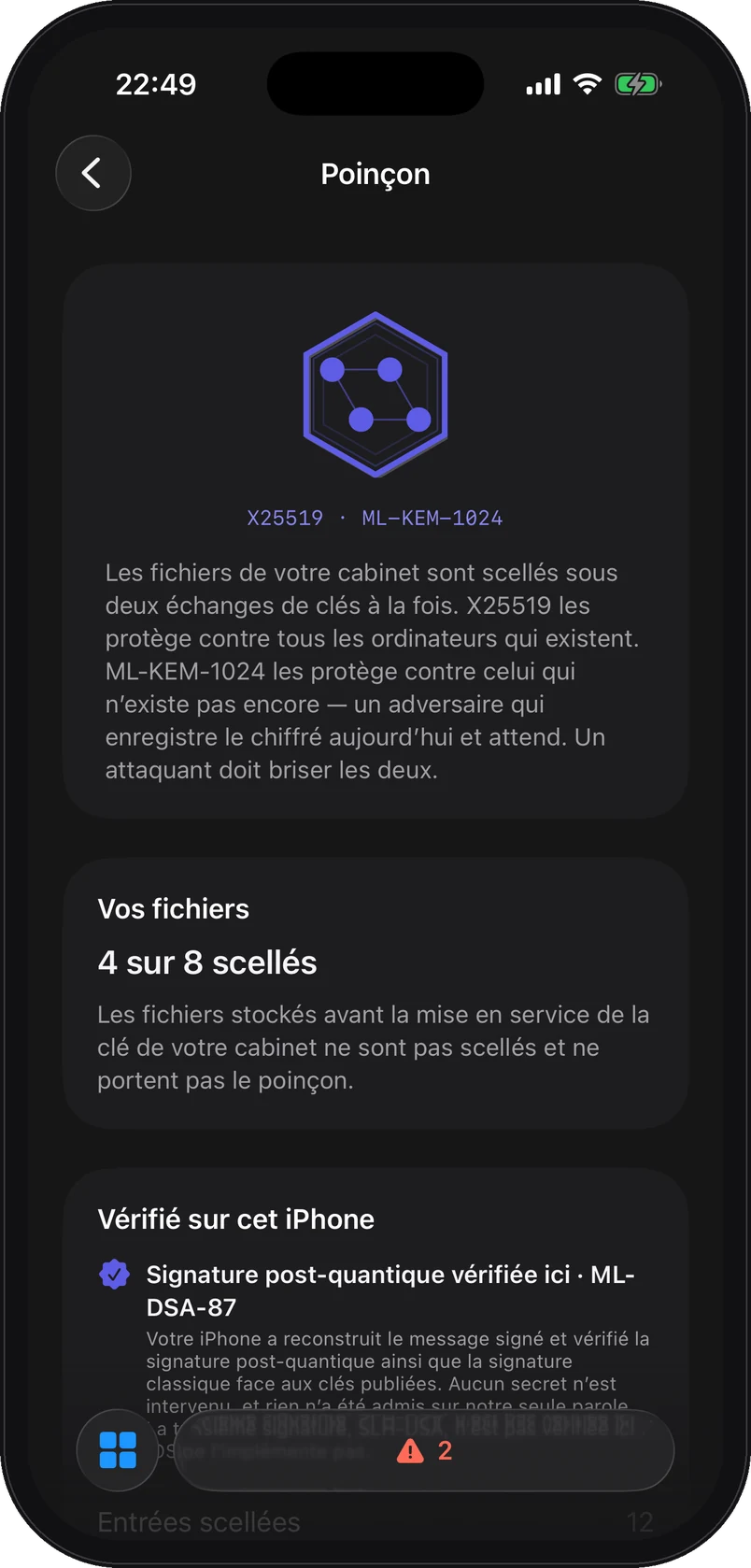
Everyday security
Cryptographic mechanisms work alongside practical controls around your data, access and decisions.
Data is separated by firm, with permissions tied to team roles.
Access rules apply at the database. A member of one firm does not gain access to another firm’s data through their account.
View the detailTwo-factor authentication, defined roles and revocable sessions support your team’s work.
The administrator manages firm access and its two-factor policy. The security pack sets out applicable rules and exceptions.
View the detailDetected names, email addresses and phone numbers are replaced with tokens before a model call.
Useful context is retained and identifiers are restored from a mapping. This replacement does not guarantee anonymity of free text. Sealing of the mapping depends on deployment.
View the detailYour team checks the prepared information and approves replies to clients.
Automatic acknowledgements use wording approved in advance. Substantive replies and decisions remain the firm’s responsibility.
View the detailTry it on this page
Encrypt the example text, recover it with the key, then change one byte of the result. See why altered content is rejected.
This bench runs the symmetric layer, AES-256-GCM, the one that seals every document on the platform. In the product, the key itself is established by the hybrid X25519 + ML-KEM-1024 exchange described above.
This demonstration runs real AES-256-GCM in your browser. The text stays on this page. It illustrates content encryption, not post-quantum key exchange.
The standards behind the words
Three NIST post-quantum standards, published in August 2024, define the mechanisms used in this architecture.
NIST FIPS 203
A mechanism designed to establish a shared secret against classical and quantum threats. Lorne & Vale uses the ML-KEM-1024 parameter set for new envelopes.
Read the standardNIST FIPS 204
A post-quantum digital signature helps verify a message’s authenticity and integrity. ML-DSA-87 signs new audit checkpoints.
Read the standardNIST FIPS 205
A different signature family, based on hash functions. It complements ML-DSA in checkpoints to diversify the mathematical approaches.
Read the standardThese standards describe algorithms. Lorne & Vale does not hold FIPS certification, ISO 27001 certification or a SOC 2 report. Using a standardised algorithm does not certify the application.
Your questions, clearly answered
No. Post-quantum cryptography uses algorithms running on today’s computers and browsers. It is designed to resist certain future attack capabilities without quantum hardware for your team.
Information in a matter may remain sensitive after it closes. The “harvest now, decrypt later” scenario concerns copies collected before a new attack capability arrives. Preparing ahead addresses exchanges at the time they happen.
The roles complement one another. AES-256-GCM encrypts the file content. Hybrid X25519 + ML-KEM-1024 protects the key needed to read it. Audit signatures verify checkpoint authenticity and help detect changes.
The scope described covers hybrid document envelopes and audit checkpoint signatures. Sessions, other data, infrastructure connections and third-party services use their own mechanisms. Active controls and any exceptions should be reviewed for the chosen deployment.
The server temporarily decrypts documents in memory for necessary operations, including inspection and some processing. Encryption protects transfers and storage within the stated scope. It does not remove the technical access required for these operations.
It is a resistance category used by NIST to compare cryptographic parameters, using exhaustive search for an AES-256 key as a reference. It does not rate the application or guarantee any period of invulnerability. ML-KEM-1024 is the highest parameter set in FIPS 203.
A transparent scope
The security pack sets out active controls, key management and any deployment transition modes. Independent cryptographic review and external penetration testing remain to be completed.
Data and files are hosted with Supabase in Ireland. The application is hosted with Vercel. OpenAI processing may take place in the United States. Applicable regions and safeguards are set out in the contractual subprocessor list.
Destroying a key makes the affected active storage unreadable. Earlier backups follow their retention window, including when they contain wrapped keys. Deletion arrangements are documented for your firm.
Architecture, controls and responsibilities, available point by point.
Every statement below can be shown in the product. Where a control is partial, the limit is written beside it.
Database access rules provide the declared separation between firms. Their coverage should be checked alongside other access paths.
Simplified diagram. One rule per table, enforced by the database and tested automatically across firms on every release.
Every member of the firm has two-step verification, and the firm can turn it into a rule.
Two-step verification and password controls for your own sign-in.
A six-digit code from your phone, required in addition to your password.
Off
Set up authenticator
Sign out the other devices and browsers where your account remains signed in.
Sign out all other devices
Require every member of the firm to set up two-step verification. Colleagues who have not yet done so are prompted the next time they open the workspace.
Four stages, each with its protection stated. Open each stage to see what an attacker walks away with if that is the one that gives.
The document is sealed on your own machine, before a single byte crosses the network, under two key exchanges at once: X25519, classical, and ML-KEM-1024, post-quantum.
Nothing readable. What leaves your browser is already sealed under two independent key exchanges. Intercepting the network yields ciphertext and nothing else.
The envelope is opened in memory, for as long as a content inspection takes: bounded size, checked type, scripts, macros and embedded programs refused. The document is then resealed under your firm’s key.
Nothing stored in the clear. This is the only stage where the document briefly exists in the clear, in memory, for the time the inspection takes. It is stored sealed. We say that rather than talk about “zero knowledge”, which this is not.
The document rests sealed under the key that belongs to your firm. One firm’s key opens nothing that belongs to another.
Nothing that opens without the firm’s key. A copy of the storage yields sealed files and nothing more.
Every download is resealed to a single-use key that your browser generates for that one transfer, then discards.
Nothing reusable. The key that opened that transfer no longer exists once the transfer is finished.
About the content inspection. It refuses scripts, macros and embedded programs, with one exception, on the record: the field-formatting scripts of a fillable PDF form. It does not replace your firm’s own endpoint protection.
Sensitive actions are recorded in an append-only log. Every entry carries the SHA-256 fingerprint of the one before it.
Your browser calculates SHA-256 hashes for these fictional entries. The example illustrates hash chaining. It does not verify a post-quantum signature from the platform.
Before any call to the model, the identifiers in the enquiry are replaced by tokens. Names are restored only inside your firm’s database.
Hello, my name is Charlotte Bennett. I am separating from my husband, Daniel Bennett, and we have two children. You can reach me on 07700 900123 or at charlotte.bennett@example.invalid.
Hello, my name is PERSON_1. I am separating from my husband, PERSON_2, and we have two children. You can reach me on PHONE_1 or at EMAIL_1.
Simplified representation of a fictional enquiry. The real tokens are neutral identifiers; the map is sealed under the firm’s key and is restored only inside your database.
Erasing one person and destroying a firm’s key are not the same operation. We do not present them as though they were.
For an individual erasure request, the active records in scope are deleted. Backups follow the retention schedule agreed with your firm, then expire. The request is recorded in the log.
When a firm withdraws its workspace, the firm’s key is destroyed. Everything sealed under it becomes unreadable in active storage, immediately. Backups taken before the destruction are kept until the end of their window, then expire: erasure is complete at that point, and we do not say “erased” before.
Let’s discuss your requirements. A founder will walk you through the architecture, the protection scope and the documents available for your firm.