Inheritance and probate · Intake

In a contested estate, the person writing to you has already waited months. Do not add to it.

An estate stalled over the family home, a will that leaves the family out, an executor who has stopped answering: people look for a solicitor in the evening, after a family call that went badly. Lorne & Vale captures the enquiry, structures it into a triage brief and puts it on the right lawyer’s desk, with a response target. You keep the decision.

  • Human review on everything
  • No legal advice
  • Live in 7 days
  • Isolated per firm
Harriet Vaughaneleanor.price@example.invalid
Estate stalled, the family homeHello, our mother died eight months ago. There are three of us and my brother will not agree to a sale of the house. The solicitor handling the estate says he cannot take it further while we disagree. Could you call me back?
Website form · Sunday eveningThe office is closed
Fictional person, address reserved for examples.
  1. Received
  2. Structured
  3. Routed
  4. Acknowledged
  5. On the iPhone
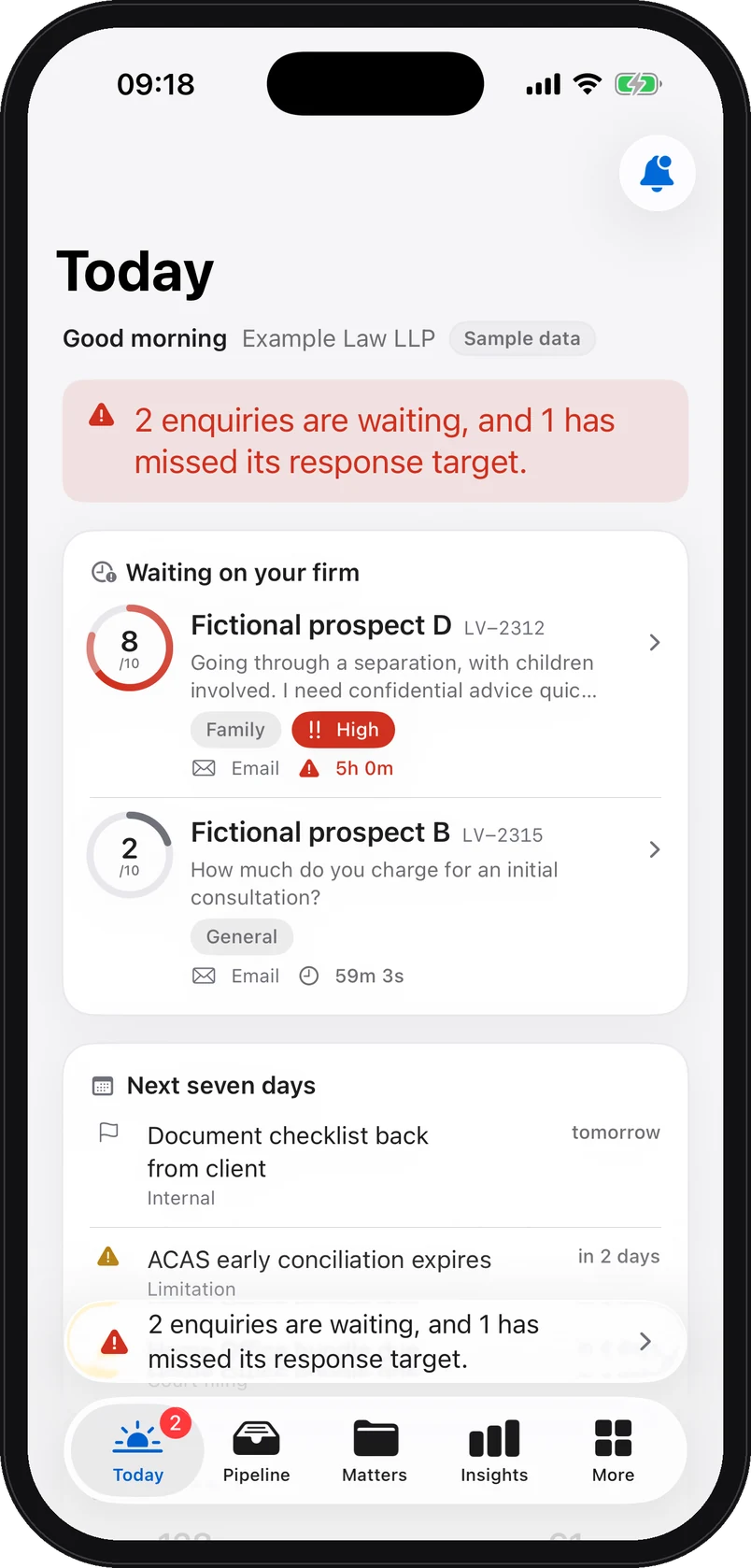
The Lorne & Vale iPhone app, Today screen: two enquiries waiting on the fictional firm, the first scored 8 out of 10, high urgency, past its response target.

Real platform and app, fictional firm and people.

A week in an inheritance and probate firm

Three situations you will recognise.

Every enquiry arrives with a triage brief: summary, urgency, parties to check, missing information, documents to request. Here is what it would surface.

Sunday, 21:05Website form

An estate stalled over the family home

Harriet Vaughan, a fictional person: “Our mother died eight months ago. There are three of us and my brother will not agree to a sale. The solicitor handling the estate cannot take it further.”

What the brief would surface
Urgency
Medium. Priority P2, first-response target of 24 hours. Watch point: an inheritance tax account may be due, for the lawyer to place on the calendar.
Parties to check
The other beneficiaries named in the enquiry and the firm administering the estate, for the conflict check.
Missing information
The date of death. Whether there is a will or the intestacy rules apply. Whether a grant of representation has issued, and to whom. Whether a sale or a buy-out has been put in writing.
Documents to request
The will, the grant of probate or letters of administration, the estate accounts as they stand, the title register for the property.
Wednesday, 08:20Forwarded e-mail

A will that leaves out a dependant

Matthew White, a fictional person: “My father’s will leaves almost everything to someone outside the family. He supported me for years. Is it too late to do anything about it?”

What the brief would surface
Urgency
High. Priority P1, first-response target of 4 hours. Watch point: a claim under the Inheritance (Provision for Family and Dependants) Act 1975 is normally brought within six months of the grant of representation, so the date of the grant is confirmed by the lawyer first.
Parties to check
The beneficiary named in the will, the executors and the other family members, for the conflict check.
Missing information
The date of death and the date of the grant, if one has issued. When the client first saw the will. The nature and length of the support received from the deceased.
Documents to request
A copy of the will, the grant of representation, the death certificate, and evidence of the support the client received.
Saturday, 19:40Missed call

A dispute over an executor’s conduct

Sophie Reed, a fictional person: “My sister is the executor. There have been no accounts in a year, money has left our father’s account, and she tells the rest of us nothing.”

What the brief would surface
Urgency
High. Priority P1, first-response target of 4 hours. Watch points: an administration still open, and an active dispute between beneficiaries.
Parties to check
The executor, the other beneficiaries and the bank holding the accounts, for the conflict check.
Missing information
The date of death and the date of the grant. What has been asked of the executor in writing, and when. The dates and sizes of the payments in question.
Documents to request
The will and the grant, any estate accounts already provided, bank statements for the period, and the correspondence with the executor.

Illustrative examples, fictional people. What a brief contains depends on the enquiry received. The brief summarises, scores and flags; it does not advise and it decides nothing. Someone at the firm assesses the merits, confirms the dates and replies.

Demonstration

A demonstration on a real enquiry.

The demonstration runs on the sample firm’s dataset: a fictional family law enquiry received at 22:47 and structured within the minute. The acknowledgement goes out in the firm’s name at 22:49, and the brief waits for the partner on the platform and on their iPhone. The screens are real, and the grid is the same for a contested estate; only what sits under each heading changes from one practice area to the next.

The triage brief

What the lawyer reads before deciding.

The same grid at 2 pm and at 11 pm. Nothing is decided in their place.

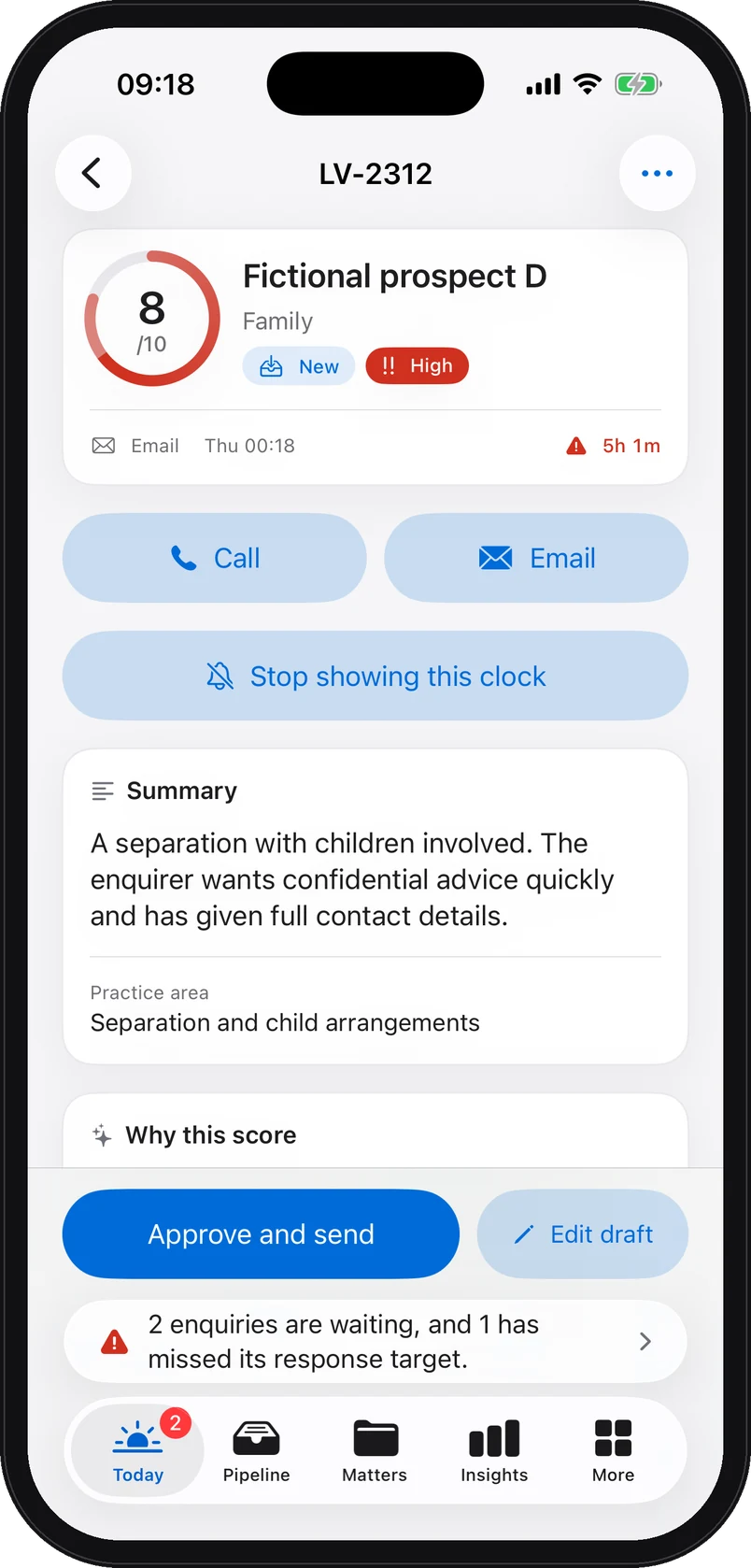
  • A score out of 10, a temperature and a priority, with the rationale in plain words. On screen: 8 out of 10, hot, priority P1, that is a first response targeted within 4 hours. On an estate enquiry it is the clarity of the account, the presence of a deadlock and an explicit request to speak to someone that carry weight.
  • Practice area, routing and next step. The practice area detected sets the suggested first contact, the partner who takes contentious probate, and the recommended step stays an offer of a call, never a position on the merits.
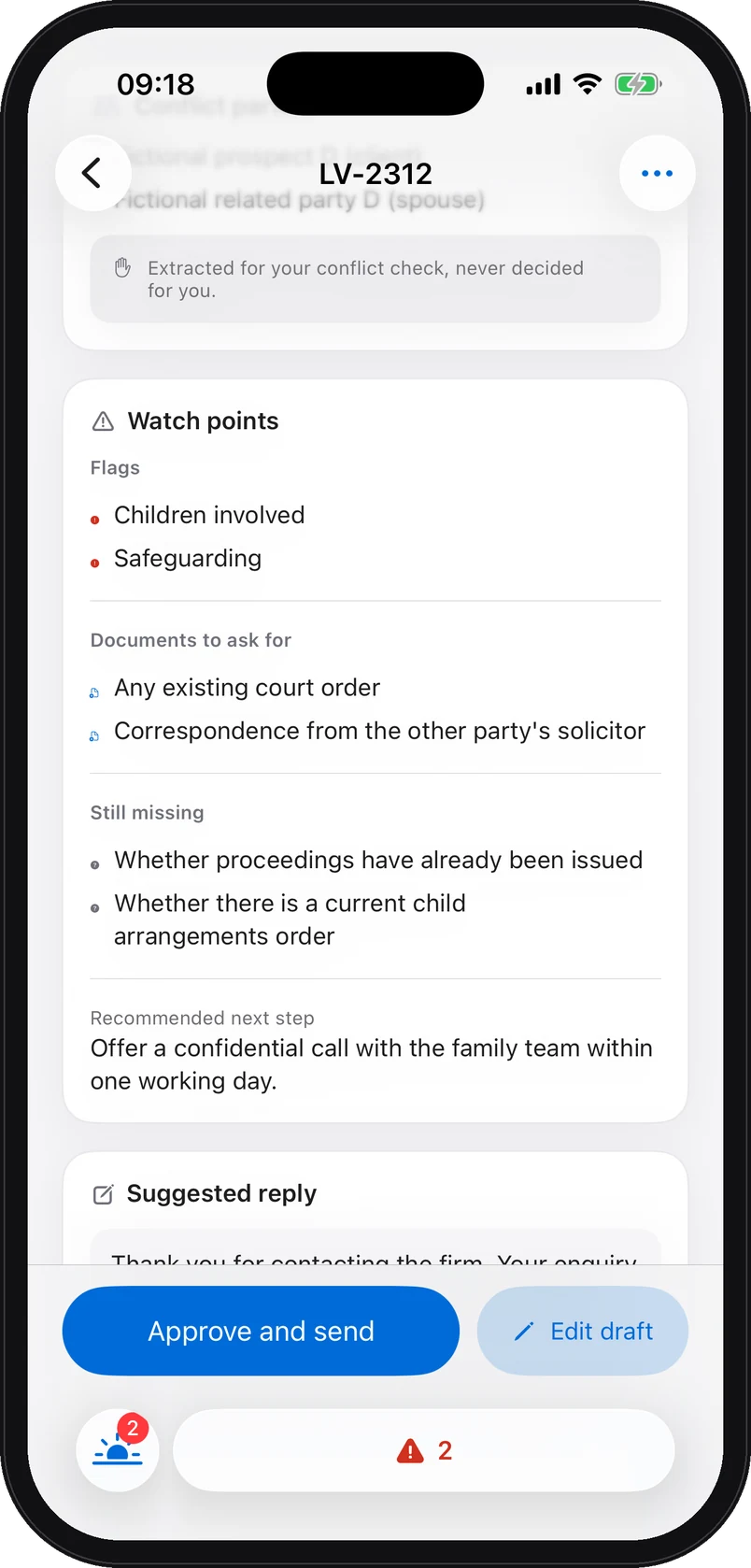
  • Needs attention. On screen: children involved. On an estate: a limitation period that may already be running, an administration stalled between beneficiaries, payments made shortly before or after the death.
  • Missing information and documents to request. The date of death, the date of the grant of representation, whether a will exists and in what form; the will and grant, the estate accounts, the title register, bank statements for the period.
  • Counterparty and conflict check. The other beneficiaries, a beneficiary named in a will and the executors are listed for your own search, extracted by the model and requiring human verification.

The person’s identifiers are replaced by tokens before any model call. Names are restored only inside your firm’s database.

The triage brief on iPhone: watch points, documents to ask for, missing information and the recommended next step, on a fictional enquiry.
Triage brief of a fictional enquiry on the platform: score 8 out of 10, practice area, priority P1, recommended next step, score rationale, watch points and parties to check.
On the iPhone

The same brief, in the partner’s pocket.

What is waiting, with its countdown. A suggested reply, marked as a draft. Two buttons: Approve and send, Edit draft.

  • A countdown on the lock screen, if the partner asks for it, and a reminder half an hour before the response target runs out. The reminder names a practice area and a score, never a client.
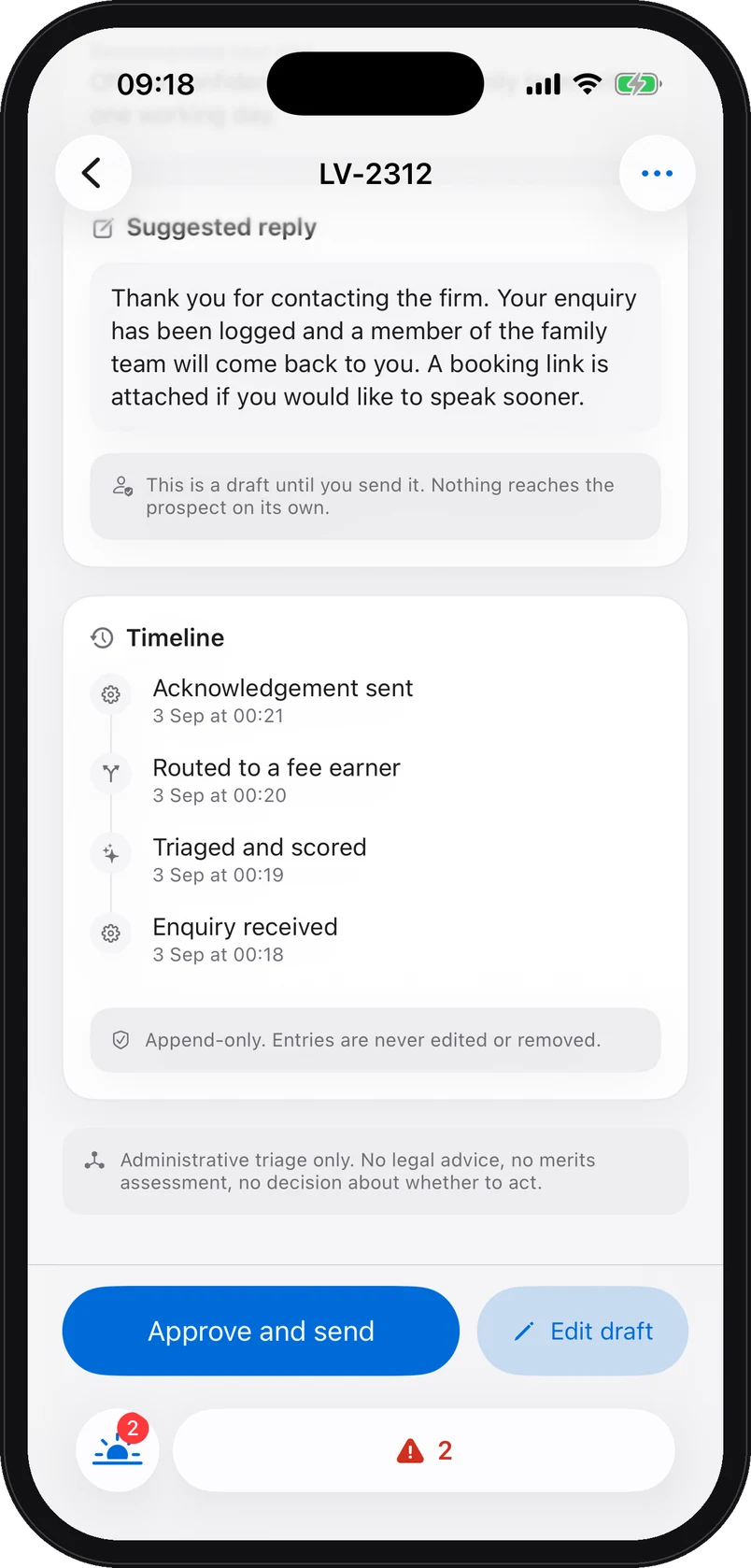
  • A draft, not a send. The suggested reply only goes out if a lawyer approves or edits it. The only thing that leaves on its own is the acknowledgement, in wording approved at setup.
  • An append-only history: received, triaged and scored, routed to a fee earner, acknowledgement sent. Entries are never edited or removed.
  • Face ID locks the app as soon as it goes to the background.
The triage brief on iPhone: score 8 out of 10, a fictional prospect, the practice area, high urgency, the summary, and the Approve and send, Edit draft buttons.
The suggested reply on iPhone, marked as a draft until it is sent, and the append-only timeline of the enquiry: received, triaged and scored, routed to a fee earner, acknowledgement sent.

Real platform and app, fictional firm and people.

What it is worth

A worked example, with its assumptions.

Not a promise: visible arithmetic, to redo with your own numbers.

Assumptions for a firm of 3 to 9 lawyers
£81,000of fees at stake a year, in this example, that is 18 matters
Enquiries received a month, all channels20
Share unanswered, answered too late or never read30%
Conversion of an enquiry handled in time25%
Fees on an estate matter, a cautious figure from a range of £3,000 to £8,000£4,500
Annual subscription, Firm tier, list price£11,940
Break-even3 matters a year

20 × 30% × 25% = 1.5 matters a month × 12 = 18 × £4,500 = £81,000 a year

“At stake” means the fees of the matters concerned, not a forecast of instructions or guaranteed revenue. The fee range is a working assumption; put your own figure in its place. The setup fee, refundable in full, is left out of the calculation.

What the research measures

67%

of law firms never reply to an enquiry sent by e-mail.

Source: Clio Legal Trends Report, secret-shopper study of 500 law firms, 2024. The figure describes observed response behaviour, not a result to expect from Lorne & Vale.

Security and confidentiality

Enquiries this personal, handled as such.

Four controls you can verify, described without superlatives.

Anonymised before any model

Names, e-mails, phone numbers and other identifiers are replaced by tokens before an enquiry reaches a model. The mapping is sealed under the firm’s key.

Isolated per firm

Every client-data table carries a per-firm access rule, checked by automated tests on every change.

Documents sealed in the browser

Every document is encrypted before upload under two key exchanges, X25519 and ML-KEM-1024. Uploads are bounded, type-checked and content-inspected: embedded programs are refused.

Chained, signed audit trail

Sensitive actions are hash-linked and the head of the chain is signed daily with ML-DSA-87. The iPhone app verifies the signature on the device.

What we do not claim: no SOC 2 or ISO 27001 certification, and no external penetration test to date. Hosting on Supabase (EU, Ireland) and Vercel; the model is called through a server-side proxy, with no training on your data under OpenAI’s default policy.

Pricing

A flat fee for the whole firm.

Inheritance and probate is the practice area included. An additional practice area is £250 per month. No per-seat or per-enquiry charge. A one-time setup fee, refundable in full under the No-Miss Guarantee. Prices exclude VAT.

Live in 7 days, a 60-day pilot then month to month, cancel any time, export your data any time. Read the guarantee in full.

Intake audit · 15 minutes

See what this would change in your firm.

Fifteen minutes with a founder. Your channels, your volume, your inheritance and probate enquiries. You leave with a costed estimate and a clear answer, including if it is not for you.

Prefer to write first? contact@lornevale.com